
Measure your screen
Knowing the exact measurements of the screen you need for your bathroom space could be complicated, since they are very precise measurements. Therefore, in this post we are going to give you some tips to make it easier for you.


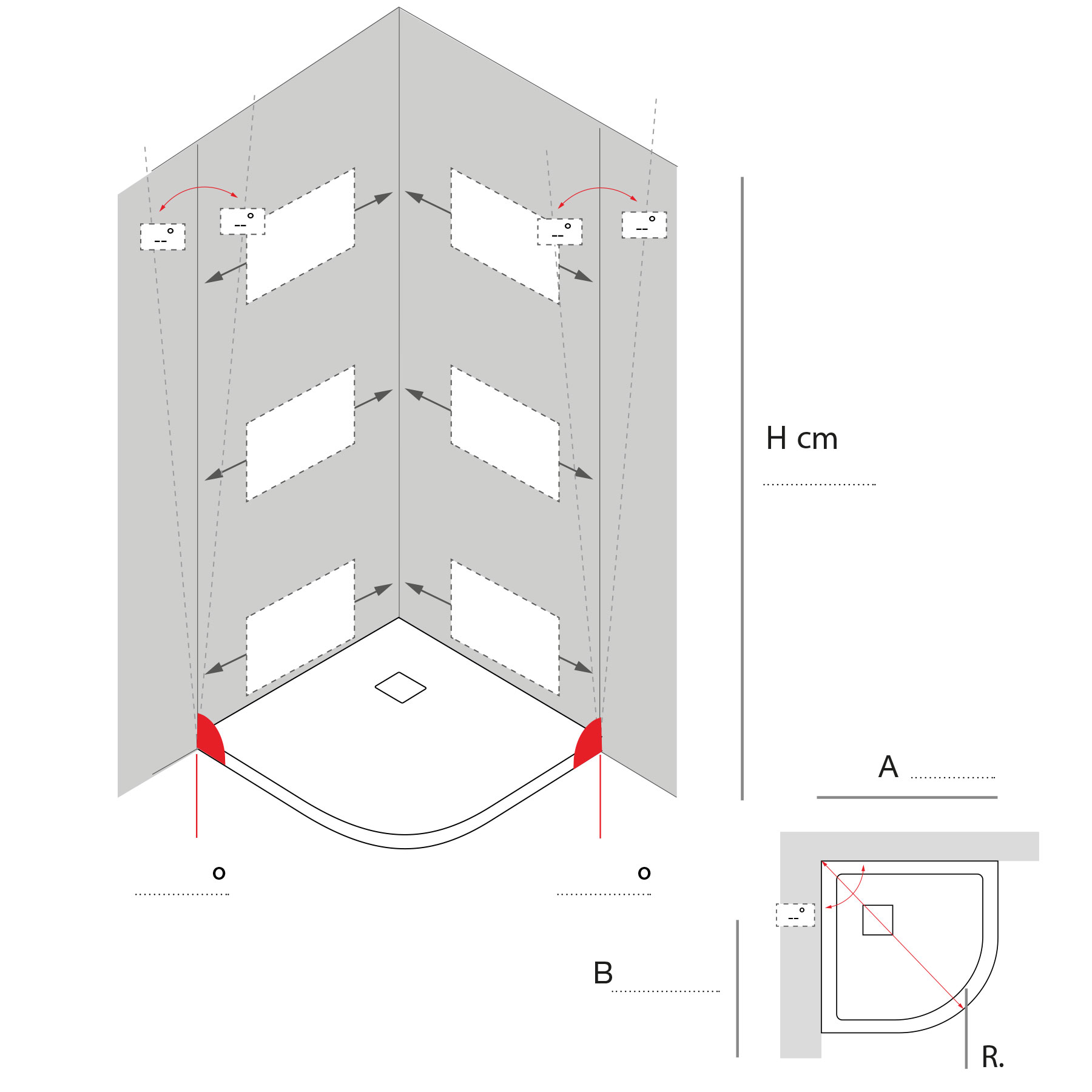
+ INFO
These are some aspects to consider:
- Check the level of the base of the screen, and that the support base is perfectly leveled. To level it, we recommend using a bubble level.
- Check the possible existence of steps. If there are unevennesses of up to 5 millimeters, they should not present problems, but if they are bigger than 5 millimeters, they must have a different treatment, since it will require a placement of leveling profiles.
- Find out where the pipes are. This way you can avoid drilling into them. It is especially important in PVC pipes, which are difficult to detect.
- Make sure the viability of the installation, that there are no windows, shelves, towel rails or any other element within the area where you want to install the screen.
Here we explain you how to measure your space according to the type of screen that you want to install, in any case, make sure to always measure twice.
Front enclosure screens
- Stick with the smallest measure of the three, and we will offset the largest measure with the offset profile.
- Check if the three measurements are within the range of a Salgar screen reference.
Example: Helsinki 22452 136-140 centimeters. Ideally, deduct 0.5 centimeters from the lowest measurement and check if they are all within the range.
- Remember that it is always the largest measure which is compensated with compensating profiles.
Example: If A = 139 cm, B = 138.5 cm, C = 138cm; we discount 0.5 to B and see that the maximum difference is 137.5 to 139 cm, that is, 1.5 cm, which is in the code range, and that the bulkhead offset (2 cm) covers the maladjustment.
Angular partitions
- Both for a plate on the ground, or a work plate / flush with the ground, it is measured from the wall to the edge of the plate.
- When the plate is on the ground, the screen is always slightly smaller than the total dimension of the plate.
Example: Helsinki, code 22465, nominal dimensions of the plate: 700x900, dimensions of the screen 675-695 and 875-895.
- In the case of a work surface or at ground level, for aesthetics the screen must fall into the joint of the plate and the floor. You should measure the two measurements up to those joints and see if the screen adjusts to them.
Semicircular partitions
For more information on how to measure your screen click here


